The global aquaculture industry is expanding at an unprecedented pace, driven by rising demand for seafood, declining wild fish stocks, and the need for more efficient protein production systems. As fish farming becomes more industrialized, feed production has emerged as the single most important factor influencing profitability, productivity, and sustainability.
In this context, automated fish feed production systems are gaining significant attention. These systems integrate advanced machinery, control systems, and processing technologies to manufacture high-quality feed with minimal human intervention. However, many investors still ask a critical question: is automated fish feed production really worth the investment?
To answer this, we must examine production efficiency, cost structure, equipment value, market demand, and long-term profitability. Key components such as the fish feed production line and the availability of fish feed machine for sale play a central role in determining the feasibility of such an investment.
This article provides a deep and structured analysis of whether automated fish feed production is worth it for modern aquaculture businesses.
1. Understanding Automated Fish Feed Production
Automated fish feed production refers to a fully or semi-automated manufacturing system that converts raw ingredients into finished fish feed pellets using integrated machinery and control systems.
Unlike manual or semi-manual operations, automated systems rely on:
- PLC control systems
- Continuous production lines
- Automatic dosing and mixing
- Precision pelletizing technology
The goal is to maximize efficiency while minimizing labor costs and production errors.
2. What Is a Fish Feed Production Line?
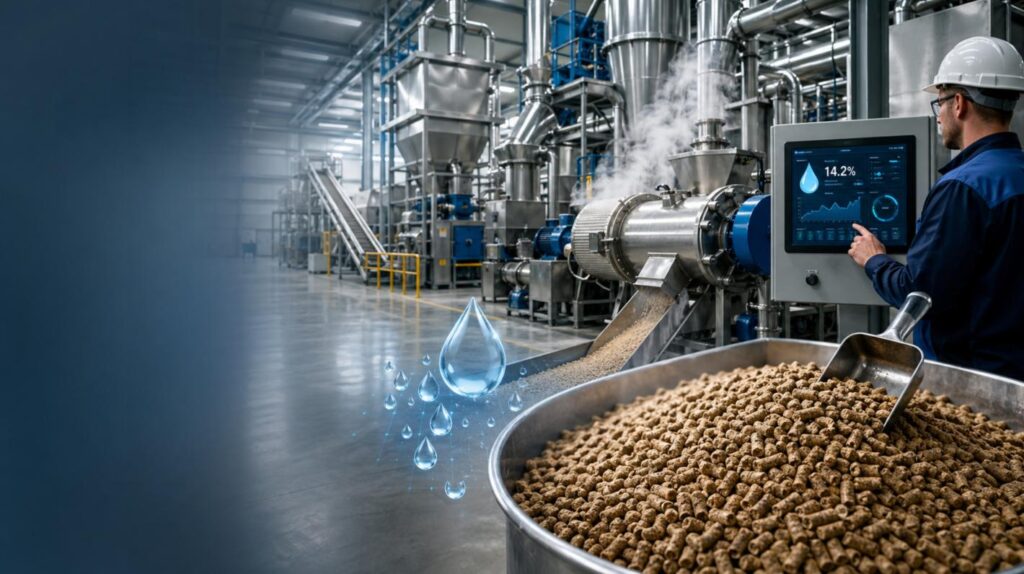
A fish feed production line is the backbone of automated feed manufacturing.
It typically includes:
- Raw material storage system
- Grinding machine (hammer mill)
- Mixing machine
- Conditioning system
- Pelletizing or extrusion system
- Drying machine
- Cooling system
- Oil coating system
- Packaging system
Each component is connected into a continuous workflow.
2.1 Why the Production Line Matters
The automatic fish feed production line ensures:
- Continuous production flow
- Consistent feed quality
- Reduced human labor
- Higher production efficiency
- Lower operational error rates
Without a production line, automation is incomplete and inefficient.
3. Economic Benefits of Automation
One of the strongest arguments for automated fish feed production is cost efficiency over time.
Although the initial investment is high, automation reduces long-term costs in several ways:
3.1 Reduced Labor Costs
Manual feed production requires:
- Multiple workers
- Continuous supervision
- Manual mixing and feeding operations
Automation reduces labor needs significantly, lowering monthly operational expenses.
3.2 Increased Production Capacity
Automated systems can run:
- 24/7 production cycles
- High-volume output
- Stable production speeds
This directly increases revenue potential.
3.3 Reduced Material Waste
Precision systems ensure:
- Accurate ingredient measurement
- Uniform mixing
- Controlled pellet formation
This minimizes raw material waste and improves profit margins.
4. Role of Fish Feed Machines in Automation
Modern automated systems rely heavily on specialized equipment.
Investors often search for fish feed machine for sale when building or expanding production capacity.
These machines include:
- Grinding machines
- Mixers
- Pellet machines or extruders
- Dryers
- Coolers
- Coating machines
Each machine plays a specific role in automation.
4.1 Importance of Equipment Quality
High-quality machines ensure:
- Stable production
- Long operational lifespan
- Lower maintenance costs
- Consistent feed quality
Cheap or poorly designed equipment can reduce efficiency and increase long-term costs.
https://pelletisingmachine.com/fish-feed-pellet-making-machine
5. How Automation Improves Feed Quality
Feed quality is critical in aquaculture because it directly affects fish growth, health, and survival rates.
5.1 Precision Formulation
Automated systems ensure:
- Accurate ingredient ratios
- Nutritional consistency
- Reduced human error
5.2 Better Pellet Structure
With controlled processes, pellets have:
- Uniform size
- Stable density
- Improved water resistance
5.3 Improved Digestibility
Automation allows:
- Proper conditioning
- Optimal moisture control
- Better nutrient absorption
This leads to faster fish growth and improved feed conversion ratio (FCR).
6. Importance of Feed Conversion Ratio (FCR)
FCR is one of the most important performance indicators in aquaculture.
It measures how efficiently fish convert feed into body weight.
6.1 How Automation Improves FCR
Automated production improves FCR by:
- Enhancing feed digestibility
- Reducing waste
- Improving pellet consistency
- Ensuring balanced nutrition
A better FCR means lower cost and higher profitability.
7. Initial Investment vs Long-Term Profit
One of the biggest concerns for investors is cost.
Automated systems require:
- Machinery investment
- Installation costs
- Factory setup
- Training and maintenance
However, the long-term benefits often outweigh the initial costs. (check this site out)
7.1 Cost Structure Breakdown
Main cost components include:
- Equipment purchase (fish feed production line)
- Raw materials
- Energy consumption
- Labor
- Maintenance
7.2 Profit Advantages
Automation increases profit through:
- Higher output
- Lower labor cost
- Reduced waste
- Better product quality
8. Market Demand for Fish Feed
The global demand for fish feed continues to grow due to:
- Expansion of aquaculture
- Increased seafood consumption
- Government support for fish farming
- Decline in wild fish stocks
This makes fish feed production a stable and growing industry.
9. Scalability of Automated Systems
One major advantage of automated production is scalability.
Businesses can:
- Start small and expand gradually
- Add new production lines
- Upgrade machinery over time
This flexibility reduces financial risk.
10. Environmental Benefits of Automation
Automated fish feed production also supports sustainability.
Benefits include:
- Reduced feed waste
- Lower water pollution
- Efficient resource utilization
- Lower carbon footprint
Sustainability is increasingly important in global food production.
11. Technology Behind Fish Feed Production Lines
Modern fish feed production lines use advanced technologies such as:
- PLC control systems
- Automatic weighing systems
- Temperature sensors
- Moisture control systems
These technologies ensure precision and consistency.
12. Maintenance and Operational Stability
Automation reduces human error but requires proper maintenance.
Maintenance includes:
- Regular cleaning
- Component replacement
- System calibration
- Lubrication of moving parts
Proper maintenance ensures long-term stability.
13. Challenges of Automated Fish Feed Production
Despite its advantages, automation has challenges:
13.1 High Initial Investment
The biggest barrier is the upfront cost of machinery and setup.
13.2 Technical Complexity
Operators must understand:
- Machine operation
- Production control
- Maintenance procedures
13.3 Raw Material Price Fluctuations
Profitability depends on stable raw material supply.
14. Comparing Manual vs Automated Production
| Feature | Manual Production | Automated Production |
|---|---|---|
| Labor cost | High | Low |
| Output capacity | Low | High |
| Feed quality | Inconsistent | Stable |
| Efficiency | Low | High |
Automation clearly offers superior performance.
15. Return on Investment (ROI)
ROI in automated fish feed production depends on:
- Production scale
- Market demand
- Operational efficiency
- Equipment quality
In most cases, well-managed factories achieve strong long-term returns.
16. Choosing the Right Fish Feed Machine for Sale
When evaluating fish feed machine for sale, investors should consider:
- Production capacity
- Energy efficiency
- Durability
- After-sales support
- Spare parts availability
Choosing the right machine directly impacts profitability.
17. Future Trends in Automated Fish Feed Production
Future developments include:
- AI-driven feed formulation
- Smart factories
- Fully automated production lines
- Real-time production monitoring
These innovations will further improve efficiency and reduce costs.
Conclusion
Automated fish feed production is a powerful investment opportunity in the rapidly growing aquaculture industry. While the initial cost of a fish feed production line and related equipment may be significant, the long-term benefits—such as higher efficiency, reduced labor costs, improved feed quality, and increased production capacity—make it a highly attractive business model.
The availability of reliable fish feed machine for sale options also makes it easier for new investors to enter the market and scale operations gradually.
Overall, automated fish feed production is not only worth the investment but is becoming essential for competitive and sustainable aquaculture businesses worldwide. (Richi Machinery)