


A rabbit producer in southern Europe once described a problem that had puzzled him for months. His rabbits were healthy. The feed formula was the same one he had used for years. But intake had dropped, and the floor under the cages was covered with pellets that had been bitten and dropped. He changed feed brands twice. He adjusted the ration. Nothing worked. The problem, as it turned out, was not the formula. It was the pellet.
The pellets were too long. Rabbits have a habit of biting off part of a long pellet and letting the remainder fall through the cage floor. In hutches with wire mesh, those dropped fragments are gone. The farmer had been paying for feed that his rabbits could not physically finish.
That story is a useful starting point because it illustrates something that feed tables and nutrition charts often miss. Rabbits are not passive eaters. They interact with the physical form of the feed. The size, hardness, durability, and surface texture of a pellet all influence whether it is eaten, dropped, or ignored. When intake falls and waste rises, the answer is often not in the formulation. It is in the processing.
This article is about that layer of rabbit production that sits between the feed formula and the animal: the physical pellet and the steps that produce it. It is written for farm managers, feed producers, and project planners who want to understand why feed waste happens and what can be done about it.
Why Rabbits Reject Pellets
Rabbits are selective eaters with a feeding behavior that differs from pigs or poultry. They pick up feed with their lips, manipulate it with their teeth, and often bite before swallowing. A pellet that is too hard may be dropped. A pellet that is too long may be partially eaten and partially discarded. A pellet that crumbles into fines may be sniffed and left alone.
Research on rabbit feed quality confirms that rabbits are among the most sensitive species to feed faults. A feed that works for another animal may fail for rabbits because of physical characteristics that other species tolerate. Fines in rabbit feed have been linked to sanitary problems and are frequently implicated in digestive and respiratory disturbances. In practical terms, the dust that accumulates under the feeder is not just wasted money. It is a health risk.
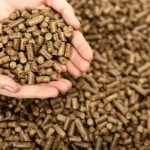
The ideal rabbit pellet is not simply a compressed version of the ration. It is a physical object designed for a specific animal. It needs to be hard enough to hold together during handling but soft enough for a rabbit to chew. It needs to be uniform in size so that rabbits do not selectively pick through the feed. And it needs to be durable enough to survive the journey from the pellet mill to the feeder without turning into powder.
The Fiber Problem: Nutrition That Fights Pellet Quality
Rabbit nutrition depends on fiber. A rabbit’s digestive system is designed for a high-fiber diet, typically containing 15% to 18% crude fiber. Without adequate fiber, rabbits develop digestive problems that can be fatal. But fiber is also the ingredient that most complicates pellet production.
Fibrous ingredients such as alfalfa hay, grass hay, and beet pulp are bulky and resistant to compression. They can improve pellet binding because fibers interlock under pressure, but excessive or poorly processed fiber makes pellets friable and prone to breakage. A pellet that looks solid when it leaves the die may crack during cooling or crumble during bagging.
The relationship between fiber and pellet quality is not linear. Research on the digestible fiber-to-starch ratio in rabbit feed has found that pellet quality improves at specific ratios. One study on Angora rabbits reported that the lowest powder content and highest durability were achieved at a digestible fiber-to-starch ratio of 1.44, while the optimal range for rabbit growth was 0.59 to 0.74. That tension between what makes a good pellet and what supports optimal growth is a real constraint that farmers and feed producers have to manage.
The practical implication is that pellet quality cannot be optimized in isolation. It has to be balanced against nutritional requirements. A formulation that produces perfect pellets but fails to support rabbit health is not a solution. A formulation that supports health but produces crumbly pellets is also not a solution. The goal is a formulation and a process that deliver both.
Processing Before the Die: Where Quality Is Decided
Experienced feed producers often say that pellet quality is decided before the material reaches the die. The relative contributions of different factors to pellet durability have been estimated as follows: diet formulation accounts for about 40%, particle size for 20%, steam conditioning for 20%, die specifications for 15%, and cooling and drying for 5%. Those numbers are approximate, but they make a clear point. The pellet mill is not the most important variable. The material and the preparation are.
Grinding and Particle Size
Rabbit feed ingredients arrive in different forms. Alfalfa may be long and stringy. Grain may be whole. By-products may be fine or clumpy. A hammer mill reduces everything to a consistent particle size before mixing.
The target particle size for rabbit feed is not as fine as for poultry feed. Large particles, above about 1.5 mm, hinder pelleting and create weak points in the finished pellet. Very fine particles can clog the die and reduce throughput. The goal is a narrow distribution of particles that bind well without packing too densely.
Grinding also affects fiber handling. Long fibers can wrap around rollers and shafts. Proper grinding shortens fibers to a manageable length without destroying the structural properties that help binding.
Mixing and Homogeneity
A rabbit eats many pellets per day. Each pellet should deliver approximately the same nutrient profile. That requires a homogeneous mix before pelletizing. But mixing rabbit feed is more difficult than mixing some other feeds because the ingredients vary widely in density and flowability.
Light, fibrous ingredients tend to float. Dense mineral premixes sink. Over-mixing can cause segregation. Under-mixing leaves pockets of concentrated nutrients. The goal is a uniform blend that feeds into the pellet mill at a consistent rate and composition.
Moisture and Conditioning
Moisture is the most common cause of pellet quality problems. Too little moisture prevents proper binding. Too much moisture causes the material to slip through the die without forming a dense pellet. Excess moisture can also make rollers slip and reduce pellet yield.
Conditioning, which adds steam or water before pelletizing, improves binding and reduces die wear. But it must be controlled. Rabbit feed formulations with high fiber content may require different conditioning parameters than high-starch formulations. The operator needs to monitor the material and adjust accordingly.
The Die and the Pellet: Matching Specifications to Rabbit Feed
The die determines the pellet’s diameter, length, and density. Rabbit feed pellets are typically 2.5 to 8 mm in diameter, with different sizes for different age groups. Young rabbits may receive 1–3 mm pellets, while adult and growing rabbits receive 4–6 mm pellets.
Die thickness and compression ratio affect hardness. A die that is too thick produces pellets that are too hard for rabbits to chew comfortably. A die that is too thin produces pellets that break too easily. The optimal specification depends on the formulation and the desired pellet characteristics.
Die condition matters as much as die specification. A worn die produces inconsistent pellets and increases fines. High-fiber ingredients like alfalfa accelerate die wear, often requiring replacement every six months under continuous operation. Budgeting for die replacement is part of normal operating cost, not an unexpected expense.
After the Die: Cooling, Storage, and the Life of a Pellet
The pellet that leaves the die is not the pellet the rabbit eats. Between the die and the feeder, the pellet passes through cooling, screening, storage, and transport. Each step can improve or degrade quality.
Cooling is often overlooked in small operations, but it directly affects durability. Pellets leave the die hot and moist. They must be cooled gradually to prevent cracking and to bring moisture down to a safe storage level. Pellets that are cooled too quickly become brittle. Pellets that are not cooled enough remain soft and prone to mold.
Moisture control during storage is critical. Mold growth and mycotoxin production occur above 12–13% moisture. Mycotoxins, especially aflatoxin, are particularly dangerous for rabbits, causing decreased feed intake, bloating, enteritis, and in severe cases, death. A bag of pellets that looks fine on the outside may be contaminated inside if moisture conditions were wrong at any point in the process.
Storage environment also affects palatability. Pellets stored in humid conditions can absorb moisture and become soft. Pellets stored in very dry conditions can become brittle and generate fines. The goal is a stable, dry environment that preserves the physical characteristics the rabbits prefer.
When On-Farm Production Fits
The decision to produce rabbit feed on the farm is not the same as the decision to buy a machine. It is a decision about feed cost, control, and consistency.
On-farm production makes sense when the farm consumes enough feed to justify the capital and operating cost of a pellet line. Ingredients are available at a cost that makes home production cheaper than purchasing finished pellets. The farm has the labor and technical capacity to manage grinding, mixing, moisture control, and cooling consistently. And the rabbits benefit from a pellet that matches their requirements more closely than a generic commercial product.
It makes less sense when feed volumes are small, ingredient sourcing is unreliable, or the farm lacks the labor to manage the process. In those cases, the cost and complexity of on-farm production may exceed the savings. A farm that buys finished feed at a reasonable price may not gain enough from home production to justify the investment.

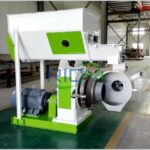
For operations that do decide to produce their own feed, the choice of a rabbit food pellet maker is one component in a larger system that includes grinding, mixing, conditioning, cooling, and storage. The configuration depends on the farm’s production flow, ingredient availability, and target pellet quality. Starting with a manageable scale and expanding later is often more practical than investing in a large system before the process is understood.
Common Mistakes That Undermine Pellet Quality
Several recurring mistakes cause on-farm pellet operations to underperform.
Skipping ingredient testing. Local ingredients vary in nutrient content and moisture. A ration that worked last month may be deficient this month. Testing is the only way to know.
Underestimating grinding. A pellet mill cannot compensate for inconsistent particle size. If the ingredients are not ground uniformly, the pellets will be inconsistent and prone to breakage.
Ignoring moisture variation. Ingredients stored in different conditions have different moisture levels. A formulation that pellets well one week may clog the die the next. Moisture monitoring and adjustment are not optional.
Cooling too quickly or not enough. Pellets that are cooled too fast become brittle. Pellets that are not cooled enough remain soft and may mold. Cooling is a controlled step, not a passive one.
Using a die that is worn or mismatched. Die condition and specification affect pellet density, hardness, and throughput. A worn die produces inconsistent pellets. A die that is too thick for the formulation may produce pellets that are too hard for rabbits to chew.
Assuming that any pellet is better than mash. A poorly made pellet is worse than a well-managed mash ration because it combines the cost of processing with the waste of fines. Pellet quality must be verified, not assumed.
A Practical Way to Assess Pellet Quality
Farmers who want to evaluate pellet quality do not need a laboratory. A few simple checks provide useful information.
Pour a sample of pellets into a bucket and look at the bottom. If there is a visible layer of fines, durability is poor. A general rule for rabbit feed is that pellet durability should not fall below 97%.
Pick up a pellet and press it between your fingers. It should offer some resistance but break with moderate pressure. A pellet that shatters is too hard. A pellet that crushes into powder is too soft.
Measure the length of several pellets. They should be uniform. Mixed lengths encourage selective feeding and increase waste.
Observe the rabbits at feeding time. Do they eat the pellets immediately? Do they drop fragments? Do they leave fines in the feeder? Rabbit behavior is one of the most reliable indicators of pellet quality.
For a more systematic approach, a rabbit food pellet maker for farm feed production can be configured with screening and cooling equipment that improve durability and reduce fines. The goal is not simply to produce pellets. It is to produce pellets that rabbits eat.
The Bottom Line
Feed waste in rabbit farming is often treated as a management problem. Farmers are told to adjust the ration, change the feeding schedule, or cull poor performers. But waste is frequently a physical problem. The pellet does not match the animal. It is too long, too hard, too soft, or too crumbly. The rabbit rejects it, and the farmer pays for feed that is never eaten.
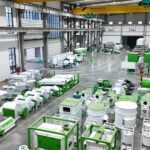
Fixing the problem requires attention to the entire production chain, from ingredient selection through grinding, mixing, conditioning, pelleting, cooling, and storage. The pellet mill is part of that chain, but it is not the whole of it.
For farms that want to understand how a complete feed production line is configured, working with an experienced manufacturer can clarify how individual machines integrate into a system. Companies like Richi Pellet Machine that serve multiple species and production scales often provide practical guidance on line configuration. If you want to understand the manufacturer’s background and approach to project support, you can check my source for more context.
A pellet that a rabbit eats is worth more than a pellet that looks good in the bag. That is the standard against which any feed production system should be measured.