


Ask any goat farmer what their single biggest expense is, and the answer comes back without hesitation: feed. It’s not even close. For most operations, feed accounts for 60% to 70% of total production costs. That’s a staggering proportion. Every dollar you earn from milk, meat, or fiber has to first pass through the stomach of your animals, and they’re not exactly frugal eaters.
Here’s the frustrating part. A significant percentage of that expensive feed never actually nourishes your goats. It’s wasted. It gets trampled into the bedding. It’s picked over and rejected. It’s blown away by the wind. It’s consumed by wild birds. The list of ways feed can be wasted is almost as long as the list of things goats will eat.
But what if you could cut that waste by half? What if you could reduce the amount of feed your goats need to gain the same amount of weight, produce the same amount of milk, or grow the same quality of fiber? What if the solution was simpler and more affordable than you ever imagined?
The Goat Digestive System: A Special Case
Goats are remarkable animals. They can thrive on browse that would starve a cow. They’re browsers, not grazers, which means they naturally prefer shrubs, leaves, and woody plants over grass. This evolutionary adaptation has made them invaluable for weed control and land management. But it also means their digestive system is optimized for fibrous, coarse materials.
That’s the good news. The bad news is that the same fibrous diet that goats thrive on is also incredibly inefficient when presented in traditional loose form. Hay and chaff are bulky, dusty, and prone to separation. The most nutritious parts—leaves, seed heads, and fine particles—often settle to the bottom of the feed trough, where goats have to work hard to reach them. Meanwhile, the coarser stems and stalks, which are less digestible, are consumed first out of convenience. The result is that goats often fill up on low-nutrition roughage while leaving the most valuable parts of their diet behind.
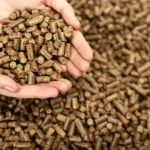
Pelleted feed changes this dynamic completely. When all ingredients are ground, mixed, and compressed into a uniform pellet, every bite delivers the same nutritional profile. Goats can’t pick and choose. They eat the whole ration, and they eat it efficiently. There’s no sorting, no separation, and minimal waste.
The Economic Argument for Pelleting
The numbers make a compelling case. In a typical meat goat operation, feed waste in loose-form feeding systems ranges from 10% to 20%, and in some cases can go as high as 30%. That means for every five bags of feed you buy, you’re literally throwing one bag away.
Pelleted feed reduces waste to roughly 2% to 3%. That’s an immediate 10% to 15% reduction in feed costs just from reduced waste alone, without changing anything else about your feeding program.
But the savings go deeper than that. The processing involved in pelleting—grinding, mixing, and steam conditioning—breaks down fibrous cell walls and gelatinizes starches, making the feed more digestible. Studies with small ruminants have shown that pelleted diets can improve feed conversion efficiency by 8% to 12%. That means your goats need less feed to produce the same amount of meat or milk. Combined with the reduction in waste, total feed savings can easily reach 20% to 25%.
For a commercial operation with 200 breeding does, feed costs might run $20,000 to $25,000 annually. A 25% reduction saves $5,000 to $6,000 per year. That’s money that goes directly to the bottom line. Over five years, that’s $25,000 to $30,000 in savings—enough to fund significant improvements to your operation.
The Equipment That Makes It Possible
So what does it take to start pelleting your own goat feed? The answer depends on your scale, but the basic technology is the same across sizes.
For most goat operations, the feed formulation is relatively simple: a blend of grains (corn, oats, barley), protein supplements (soybean meal, sunflower meal), forage meals (alfalfa or grass hay), minerals, and sometimes molasses for palatability. These ingredients are ground to a uniform particle size, thoroughly mixed, and then fed into a machine that compresses the mixture into dense pellets.
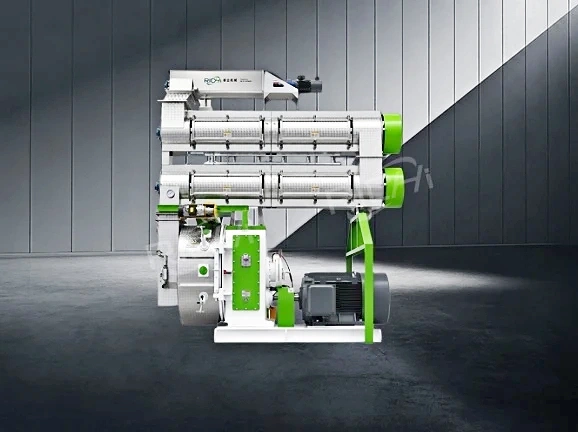
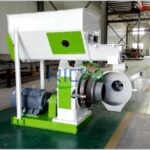
A pellet maker for animal feed is the essential piece of equipment. Unlike wood pellet mills, which have relatively simple requirements, animal feed pellet makers must handle a wider range of particle sizes and moisture levels. They also need to produce pellets of specific diameters—typically 3-8 mm for goats and other small ruminants—that are hard enough to withstand transport but not so hard that they cause dental problems.
For larger operations, these machines are often ring-die configurations with capacities measured in tons per hour. They include conditioners that add steam and moisture to improve binding and pellet quality. They are heavy-duty, designed for continuous operation over many years.
Why Goat Feed Pelleting Is Different
Here’s where it gets interesting. Goat feed is not the same as feed for cattle, pigs, or poultry. Goats are “concentrate selectors,” which means they have specific preferences for the size, texture, and density of their feed. If the pellets are too hard, they’ll reject them. If they’re too soft, they’ll crumble into dust, which goats avoid because it can cause respiratory issues.
A low consumption goat feed pellet making machine addresses these specific requirements. The term “low consumption” in this context has two meanings. First, it refers to lower energy consumption per ton of output—a critical factor for operations where electricity costs are significant. Second, it reflects the machine’s ability to produce pellets that are efficiently consumed by goats, with minimal waste and optimal intake.
These machines typically use flat-die configurations, which are better suited for small to medium production volumes and produce a slightly softer pellet that goats find palatable. The die hole sizes and compression ratios are optimized for the fibrous nature of goat feed, which includes a higher proportion of roughage than poultry or swine diets. Many models include built-in conditioners and variable-speed drives that allow operators to fine-tune the pellets for different age groups and production stages.
The Farmer Who Stopped Buying Commercial Feed
Javier had been raising dairy goats in southern Spain for fifteen years. His herd of 150 does produced milk that went to a local cheese maker. The business was stable, but not growing. Every year, the feed bill crept higher. Every year, his margins got a little tighter.
He calculated that he was spending about €18,000 annually on commercial goat pellets. The quality was inconsistent—some batches were dusty, some were too hard, and his goats would sometimes go off their feed entirely when the supplier changed formulations.
Then he visited a neighbor who had installed a small feed mill and was producing his own pig feed. The concept clicked. Javier started researching equipment for goats specifically. He sourced a low consumption goat feed pellet making machine and began experimenting with his own formulations. He used his own hay, purchased grains in bulk from local farmers, and added minerals to meet his specific herd’s requirements.
The results were dramatic. His feed costs dropped by 35% in the first year. Milk production actually increased because the goats were eating more consistently and digesting their feed better. The pellets he produced were exactly the size and hardness his goats preferred. The business transformed. He’s now expanded to 250 does and is considering offering custom pelleting services to neighboring farms.
Beyond the Machine: The Complete Picture
A quality pellet machine is the heart of the operation, but it’s not the whole system. Effective feed pelleting requires attention to the entire production chain.
Raw material preparation is critical. Grains need to be ground to the correct particle size—too coarse and the pellets will break apart, too fine and they may be too dense. Forage meals need to be incorporated carefully to maintain the fiber content that goats need for rumen health. A hammer mill or crusher is usually necessary to achieve the right consistency.
Mixing is equally important. The ingredients must be thoroughly blended before pelleting. Any unevenness in the mix will result in inconsistent pellet quality and nutrient variability. A horizontal or vertical mixer with adequate capacity is essential.
Conditioning can also improve pellet quality. Adding steam or water to the mash before it enters the pellet chamber softens the natural binders in the feed, resulting in harder, more durable pellets. Some machines include built-in conditioners, while others require separate equipment.
Cooling and screening complete the process. The hot pellets emerging from the machine must be cooled to ambient temperature to harden properly and prevent spoilage. A simple cooler can be as straightforward as a conveyor with a fan. Finally, a screening system removes fines and broken pellets, which are recycled back into the process.
Making Your Own Feed: The Strategic Advantages
Beyond the cost savings, producing your own feed pellets gives you control over your input quality. You know exactly what’s going into your goats. You’re not dependent on suppliers who may switch formulations without notice. You can adjust rations seasonally based on the availability and price of ingredients. And you can incorporate locally produced grains and forages, supporting your local agricultural economy and reducing transport costs.
This control is particularly valuable in volatile feed markets. When grain prices spike, commercial feed prices spike with them. If you’re producing your own feed, you can make sourcing decisions based on local prices and availability, often insulating yourself from global market shocks.
A Word on Getting Started
The transition to on-farm pelleting requires planning and investment, but it’s more accessible than most farmers think. Start by calculating your current feed costs and estimating the savings from pelleting. Use those numbers to build a realistic business case.
Next, evaluate your ingredient sources. Do you have reliable access to grains, protein meals, and forage materials? Can you store them properly? The answer to these questions will determine whether pelleting on your farm is practical.
Finally, choose equipment that matches your scale and goals. A pellet maker for animal feed that’s too small will limit your growth. One that’s too large will burden you with unnecessary capital and operating costs. Work with a supplier who understands goat nutrition and can help you design a system that works for your specific operation.
For those ready to take the next step, detailed information on specifications, installation, and operating costs is available. read here for comprehensive resources that will help you make an informed decision.
Conclusion
Goat farming has always been a business of tight margins. The animals are hardy, adaptable, and relatively low-maintenance, but feed costs can consume your profits before you even realize it. Pelleting your own feed isn’t just about saving money—it’s about taking control of your operation and building resilience against market volatility.
The technology is mature, the equipment is accessible, and the benefits are proven. Farmers around the world are discovering what Javier discovered in Spain: that the same grains and forages they were already buying can be transformed into a superior product that costs less to produce and performs better in the field.
Your goats need to eat. That’s not going to change. But how they eat—and how much that eating costs you—is entirely within your control. The pellet machine is the tool. The savings are the outcome. And the opportunity is waiting for those who are ready to seize it.