

Cat litter is one of the most important daily-use products for cat owners. A good litter product does much more than simply absorb liquid. It should provide effective moisture absorption, strong odor control, low dust, suitable particle size, good clumping performance when required, and a comfortable experience for cats and their owners.
As the global pet-care market becomes increasingly competitive, cat litter manufacturers need to focus not only on raw materials but also on formulation, processing technology, equipment selection, and quality control. A well-designed complete cat litter production line can help manufacturers consistently transform suitable raw materials into high-quality finished litter.
Whether the product is made from bentonite, wood, tofu, corn, cassava, or other biomass materials, the manufacturing process directly influences its final performance. This article explains the key characteristics of good quality cat litter, the factors that affect them, and how a complete production system can be designed to produce consistent products at commercial scale.
1. What Is Good Quality Cat Litter?
Good quality cat litter should satisfy the needs of both cats and their owners.
From the cat’s perspective, important characteristics include:
- Comfortable texture
- Suitable particle size
- Low dust
- Acceptable odor
- Easy movement across the litter surface
For owners, important characteristics include:
- High absorption
- Effective odor control
- Strong clumping
- Easy scooping
- Low tracking
- Consistent quality
- Convenient packaging
Different litter types may prioritize different characteristics.
For example, bentonite litter is often valued for strong clumping, while wood and tofu litter may focus on plant-based materials and lightweight handling.
2. Raw Material Quality Is the Foundation
The first factor affecting cat litter quality is the raw material.
Common cat litter materials include:
- Bentonite
- Wood fiber
- Sawdust
- Soybean residue
- Corn fiber
- Cassava
- Wheat fiber
- Rice husk
- Bamboo fiber
- Recycled paper
Each material has different physical characteristics.
For example, bentonite can provide strong swelling and clumping properties, while wood fiber can provide a lightweight, plant-based alternative.
Raw materials should be evaluated for:
- Moisture
- Particle size
- Absorption
- Cleanliness
- Bulk density
- Odor
- Pelletizing performance
Using inconsistent raw materials makes consistent finished-product quality difficult to achieve.
3. Absorption Capacity
Absorption is one of the most important characteristics of cat litter.
A high-quality litter should absorb urine efficiently and retain the liquid instead of allowing it to spread throughout the litter box.
Absorption depends on:
- Raw material structure
- Particle size
- Porosity
- Density
- Moisture
- Processing method
Different raw materials have different absorption characteristics.
Plant fibers, for example, contain porous structures that can hold liquid, while bentonite absorbs liquid through mineral swelling.
Manufacturers should test absorption under standardized conditions before commercial production.
4. Clumping Strength
For clumping cat litter, strong clumping is essential.
When liquid contacts the litter, the particles should form a stable mass that can be removed easily with a scoop.
Good clumping performance should provide:
- Rapid clump formation
- Strong clump structure
- Low breakage
- Good liquid retention
- Easy scooping
Clumping performance depends on:
- Raw material
- Binder
- Particle size
- Moisture
- Density
- Pelletizing or granulation conditions
A weak clump can break apart during cleaning and leave contaminated material behind.
5. Fast Absorption
Absorption speed is also important.
If liquid remains on the surface for too long, it can spread throughout the litter box.
High-quality litter should allow liquid to penetrate the particles quickly.
Absorption speed can be influenced by:
- Particle size
- Surface area
- Porosity
- Density
- Raw material structure
Manufacturers should balance absorption speed with pellet durability.
Extremely loose particles may absorb quickly but can generate more dust and break apart easily.
6. Odor Control
Odor control is one of the main reasons consumers choose premium cat litter.
Urine and feces can generate unpleasant odors if they are not effectively managed.
Odor-control strategies may include:
- Rapid absorption
- Strong clumping
- Activated carbon
- Mineral adsorbents
- Plant-derived odor-control materials
- Suitable fragrances
However, fragrance should not simply be used to cover poor odor management.
A well-designed product should first control moisture and odor through effective absorption and appropriate material selection.
7. Low Dust
Low dust is another critical quality indicator.
Excessive dust can be inconvenient during:
- Pouring
- Scooping
- Transportation
- Packaging
- Cleaning
Dust can be generated during:
- Crushing
- Grinding
- Pelletizing
- Drying
- Cooling
- Screening
- Conveying
Manufacturers can reduce dust by improving pellet durability, optimizing grinding, screening out excessive fines, and installing appropriate dust collection systems.
8. Suitable Particle Size
Particle size strongly affects user experience.
Very fine litter may provide good surface coverage but can create more dust and tracking.
Very large particles may reduce dust but can behave differently in terms of absorption and clumping.
Manufacturers should select particle size according to:
- Cat comfort
- Absorption
- Clumping
- Dust
- Tracking
- Product positioning
A screening system is normally required to maintain consistent particle size.
9. Pellet Durability
For pelletized cat litter, durability is important.
Pellets should remain stable during:
- Transportation
- Storage
- Packaging
- Pouring
- Use
If pellets break easily, the finished product may generate excessive fines.
Pellet durability depends on:
- Raw material
- Moisture
- Binder
- Particle size
- Pellet mill pressure
- Die specifications
- Drying conditions
- Cooling
Manufacturers should perform durability tests on finished products.
10. Moisture Content
Moisture has a major influence on cat litter quality.
Too much moisture can cause:
- Poor storage stability
- Soft pellets
- Product sticking
- Microbial concerns for unsuitable materials
- Higher transportation weight
Too little moisture during pelletizing can result in:
- Weak pellet formation
- Increased fines
- Unstable production
Therefore, moisture must be controlled at several stages.
Raw materials should be tested before processing, and finished products should also be checked before packaging.
11. Density
Density influences both product handling and absorption.
High-density pellets may be:
- Stronger
- More compact
- More resistant to breakage
However, excessive density can affect liquid penetration.
Lower-density pellets may provide faster liquid absorption but may be more fragile.
The ideal density depends on the product type and intended application.
Manufacturers should optimize density through raw material preparation, moisture control, formulation, and pellet mill settings.
12. Low Tracking
Tracking occurs when litter particles stick to a cat’s paws and are carried outside the litter box.
Although tracking cannot be completely eliminated, manufacturers can reduce it through product design.
Factors include:
- Particle size
- Particle shape
- Density
- Surface characteristics
- Pellet durability
A balanced particle-size distribution can help reduce excessive tracking.
Some manufacturers also offer specialized larger-particle formulas for consumers who prioritize low tracking.
13. Cat-Friendly Texture
Cats can be selective about litter texture.
A product may perform well technically but still be rejected if the particles feel uncomfortable.
Important considerations include:
- Particle size
- Surface texture
- Hardness
- Dust
- Scent
Manufacturers should therefore conduct practical product testing rather than relying only on laboratory measurements.
14. Different Raw Materials Produce Different Litter
Not all cat litter should be manufactured using the same process.
Bentonite Litter
Usually focuses on:
- Clumping
- Absorption
- Swelling
- Particle size
- Dust
Wood Litter
Usually focuses on:
- Absorption
- Pellet durability
- Lightweight characteristics
- Plant-based positioning
Tofu Litter
Often focuses on:
- Clumping
- Absorption
- Low dust
- Plant-based ingredients
Corn or Agricultural Fiber Litter
May focus on:
- Absorption
- Lightweight characteristics
- Biodegradable or plant-based positioning
The manufacturing process should therefore be customized to the raw material.
15. The Importance of Raw Material Preparation
Before the main forming stage, biomass materials may need:
- Cleaning
- Crushing
- Grinding
- Drying
- Batching
- Mixing
Proper preparation improves material consistency.
For example, sawdust with inconsistent particle size can produce unstable pellets.
Wet soybean residue can make pelletizing difficult if it is not properly dried.
Therefore, raw material preparation is a fundamental part of product quality.
16. Grinding and Particle Size Control
Grinding creates a more uniform feedstock for pelletizing.
A hammer mill is commonly used for suitable biomass materials.
Grinding quality affects:
- Pellet formation
- Pellet strength
- Density
- Surface quality
- Dust generation
However, grinding should be optimized rather than maximized.
Grinding material excessively fine increases electricity consumption and may increase dust without providing significant benefits.
17. Moisture Conditioning
Before pelletizing, the material should have an appropriate moisture level.
A moisture-control system can add water when required.
The system may include:
- Water tank
- Pump
- Flow meter
- Spray nozzles
Uniform moisture distribution is important.
If some material is too wet while other material is too dry, pellet quality can vary significantly.
18. Pelletizing and Granulation
Pelletizing is an important forming process for many plant-based cat litters.
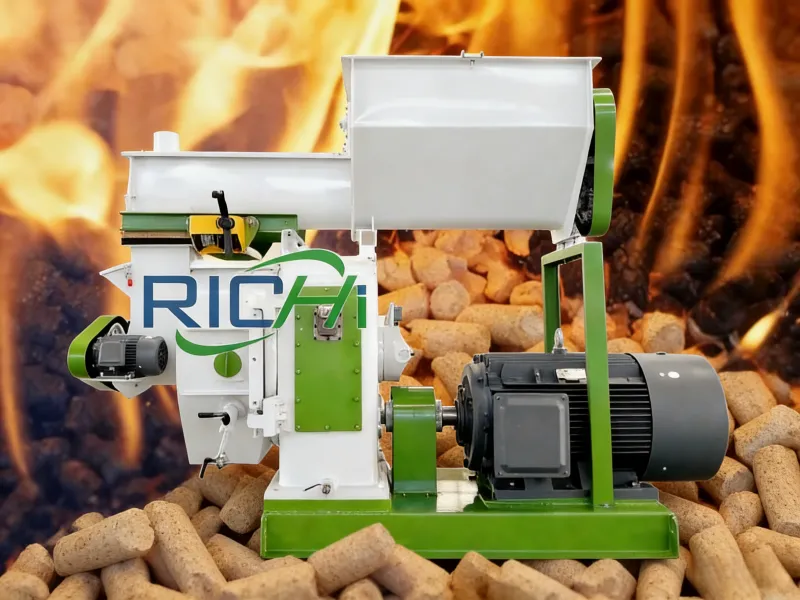
A pellet mill compresses the prepared material through a die.
The resulting pellets can be cut to the desired length.
Pelletizing affects:
- Density
- Shape
- Durability
- Particle size
- Surface characteristics
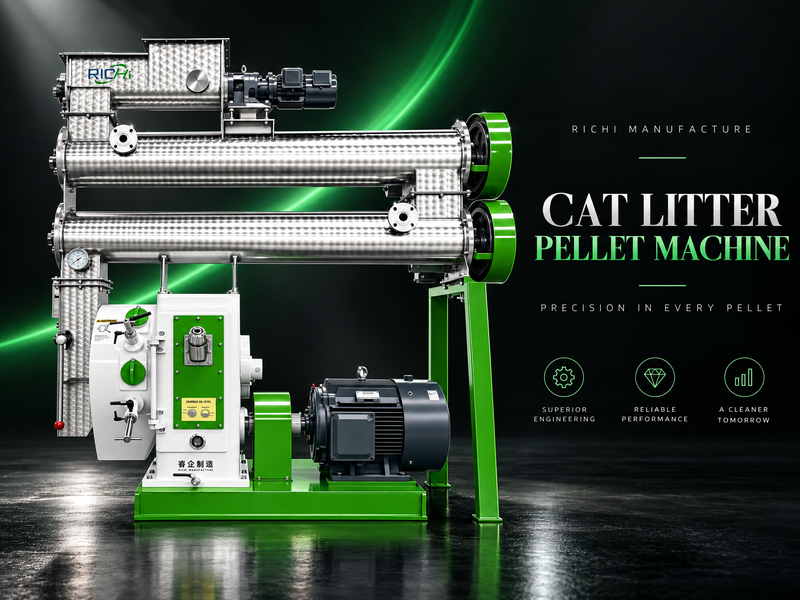
For other cat litter products, a granulator may be more appropriate.
The forming equipment should be selected based on the product design rather than using the same machine for every raw material.、
https://pelletisingmachine.com/cat-litter-pellet-machine
19. Drying
Drying is essential for many biomass-based cat litter products.
The purpose is to achieve stable moisture while maintaining pellet quality.
A drying system should provide:
- Uniform heat
- Stable airflow
- Controlled residence time
- Efficient moisture removal
Over-drying can increase energy consumption.
Under-drying can reduce storage stability.
Therefore, dryer performance should be continuously monitored.
20. Cooling
After drying, the product should be cooled before packaging.
Cooling helps:
- Reduce product temperature
- Improve storage stability
- Prevent condensation
- Protect packaging
- Prepare the product for screening
A properly sized cooler should match the production capacity of the pelletizing and drying sections.
21. Screening
Screening is essential for controlling particle size and dust.
A screening machine separates:
- Finished particles
- Fine powder
- Broken pellets
- Oversized particles
A well-designed screening process can improve product consistency.
Suitable fines may be recycled when appropriate.
This helps reduce material waste and improve production efficiency.
22. Dust Collection
Professional cat litter factories should incorporate dust collection systems.
Dust collection equipment can include:
- Cyclones
- Baghouse filters
- Exhaust fans
- Ductwork
Dust collection points may be installed around:
- Crushers
- Hammer mills
- Pellet mills
- Dryers
- Screens
- Packaging machines
Effective dust management helps maintain a cleaner working environment and reduces product losses.
23. Packaging Quality
Packaging also affects the perceived quality of cat litter.
A good package should:
- Protect the product from moisture
- Prevent contamination
- Be easy to transport
- Be convenient to store
- Clearly communicate product information
Automatic packaging equipment can improve filling accuracy and production efficiency.
Common package sizes include 5 kg, 6 kg, 10 kg, and 15 kg, although the best size depends on the target market.
24. What Is a Complete Cat Litter Production Line?
A complete cat litter production line integrates multiple processing stages into one coordinated manufacturing system.
For plant-based pellet litter, a typical line may include:
Raw Material Receiving
↓
Cleaning
↓
Crushing
↓
Grinding
↓
Drying
↓
Batching
↓
Mixing
↓
Moisture Adjustment
↓
Pelletizing
↓
Drying
↓
Cooling
↓
Screening
↓
Coating or Odor Treatment
↓
Packaging
This integrated configuration helps manufacturers control the complete production process.
25. Main Equipment in a Complete Production Line
A commercial cat litter machine system may include:
Raw Material Equipment
- Receiving hopper
- Conveyor
- Storage bin
- Feeder
Pretreatment Equipment
- Cleaner
- Crusher
- Magnetic separator
- Hammer mill
Conditioning Equipment
- Dryer
- Batching machine
- Mixer
- Moisture spraying system
Forming Equipment
- Pellet mill
- Granulator
- Forced feeder
Finishing Equipment
- Dryer
- Cooler
- Vibrating screen
- Coating machine
Packaging Equipment
- Automatic weighing machine
- Bagging machine
- Sealing machine
Environmental Equipment
- Cyclone
- Dust collector
- Bag filter
Not every project requires every machine. The final configuration should depend on raw materials and product specifications.
26. How Production Line Design Affects Quality
The production line should be designed as an integrated system.
For example, if the grinder produces inconsistent particles, pelletizing performance may become unstable.
If the dryer is too small, the entire production line may experience a bottleneck.
If the screen is insufficient, excessive fines can enter the final package.
If the packaging system is too slow, finished products may accumulate.
Therefore, equipment capacity should be properly matched throughout the line.
27. How to Improve Cat Litter Quality Through Process Control
Manufacturers can improve quality by monitoring critical process parameters.
These include:
- Raw material moisture
- Grinding particle size
- Formula accuracy
- Mixing uniformity
- Conditioning moisture
- Pelletizing pressure
- Drying temperature
- Cooling performance
- Screening efficiency
Automation can make this monitoring more reliable.
PLC systems can help coordinate different sections and provide operators with production information.
28. Quality Control From Raw Material to Finished Product
A professional quality-control system should cover three stages.
Incoming Material Inspection
Check:
- Moisture
- Cleanliness
- Particle size
- Odor
- Material consistency
Process Inspection
Monitor:
- Grinding
- Mixing
- Moisture
- Pelletizing
- Drying
Finished Product Inspection
Test:
- Absorption
- Clumping
- Dust
- Particle size
- Durability
- Moisture
- Density
- Odor control
This three-stage system can help maintain stable quality.
29. How to Make Clumping Cat Litter Better
If manufacturers want to produce premium clumping litter, several factors should be optimized.
First, choose raw materials with suitable absorption and binding properties.
Second, control particle size.
Third, develop an appropriate binder system.
Fourth, maintain stable moisture.
Fifth, optimize pelletizing pressure.
Finally, test clump strength under practical conditions.
A good clump should form quickly and remain intact during scooping.
30. How to Reduce Dust
Several measures can be used together.
Improve Pellet Durability
Stronger pellets generate fewer broken particles.
Optimize Grinding
Avoid unnecessarily fine grinding.
Improve Screening
Remove excess fines before packaging.
Optimize Conveying
Reduce excessive mechanical impact.
Install Dust Collection
Capture airborne dust at major processing points.
These measures can significantly improve finished-product appearance and handling.
31. How to Improve Odor Control
Odor management starts with fast liquid absorption.
The faster urine is absorbed and contained, the less opportunity there is for odor to develop.
Manufacturers can combine:
- High-absorption materials
- Strong clumping
- Activated carbon
- Mineral adsorbents
- Suitable plant-based odor-control ingredients
Product testing should be conducted before selecting a final formula.
32. How to Improve Production Efficiency
High product quality should be combined with efficient production.
Manufacturers can improve efficiency by:
- Using appropriate raw materials
- Matching machine capacities
- Automating material handling
- Optimizing dryer operation
- Recycling suitable fines
- Reducing unnecessary grinding
- Implementing preventive maintenance
Energy consumption should also be monitored, especially in systems that require substantial drying.
33. Small-Scale vs. Large-Scale Production
A small production facility may use:
Grinding → Mixing → Pelletizing → Drying → Cooling → Screening → Packaging
A large factory may use:
Automatic Receiving → Cleaning → Crushing → Grinding → Drying → Batching → Mixing → Pelletizing → Drying → Cooling → Screening → Treatment → Packaging → Palletizing
The appropriate scale depends on:
- Market demand
- Investment budget
- Raw material availability
- Target capacity
- Product range
Starting with a manageable capacity can allow manufacturers to test the market before expanding.
34. How to Choose Equipment
When selecting cat litter production equipment, manufacturers should consider:
Raw Material
What material will be processed?
Capacity
How many tons per hour are required?
Product Size
What particle diameter is desired?
Moisture
How wet is the incoming material?
Product Type
Is the product clumping or non-clumping?
Automation
How much automatic control is needed?
Packaging
What bag sizes will be used?
Equipment should be selected based on the complete production process rather than individual machine price alone.
35. RICHI Complete Cat Litter Production Line
RICHI Manufacture provides customized solutions for manufacturers that want to establish a complete cat litter production line.
Depending on the product, raw material, and capacity, the production line can include:
Raw Material Preparation → Crushing → Grinding → Drying → Batching → Mixing → Moisture Adjustment → Pelletizing/Granulation → Drying → Cooling → Screening → Coating → Packaging
The line can be customized according to:
- Bentonite
- Sawdust
- Wood fiber
- Soybean residue
- Corn fiber
- Bamboo fiber
- Other suitable plant-based materials
Production capacity, pellet size, density, moisture, formulation, packaging, and factory layout can all be considered during engineering design.
RICHI can provide turnkey services covering customized production line design, equipment manufacturing, overseas transportation and customs clearance, installation and commissioning, operator training, spare parts supply, and long-term technical support.
This integrated approach helps ensure that individual machines work together efficiently.
36. Maintenance and Long-Term Quality
Even the best equipment cannot maintain quality without proper maintenance.
Important maintenance tasks include:
- Inspecting pellet mill rollers
- Checking dies
- Lubricating bearings
- Cleaning screens
- Checking conveyors
- Inspecting dryers
- Cleaning dust collectors
- Checking motors
- Replacing wear parts
Preventive maintenance helps reduce unexpected downtime and maintain stable product quality.
37. How to Build a High-Quality Cat Litter Brand
Manufacturing high-quality litter is only one part of building a successful brand.
Manufacturers should also focus on:
- Stable product specifications
- Attractive packaging
- Reliable supply
- Consistent quality
- Product testing
- Customer feedback
- Appropriate pricing
- Clear product positioning
A good production system provides the foundation for reliable product consistency.
38. Future Trends in Cat Litter Quality
The cat litter market is likely to continue developing toward products with improved convenience and performance.
Potential trends include:
- Low-dust litter
- Stronger clumping
- Faster absorption
- Improved odor control
- Plant-based litter
- Lightweight litter
- Biodegradable materials
- Better pellet durability
- More automated production
- More efficient manufacturing
Manufacturers that combine product innovation with efficient production may be better positioned for long-term growth.
Conclusion
Good quality cat litter is the result of multiple factors working together. Raw material quality, absorption, clumping strength, particle size, moisture, density, durability, dust control, odor management, and packaging all influence the final product.
For plant-based litter, the production process generally includes:
Raw Material → Cleaning → Crushing → Grinding → Drying → Batching → Mixing → Moisture Adjustment → Pelletizing → Drying → Cooling → Screening → Odor Treatment → Packaging
For bentonite and other mineral-based products, the processing route may be different, with crushing, grinding, granulation, drying, and screening configured according to mineral characteristics.
A complete cat litter production line allows manufacturers to integrate these processes into one coordinated system. Properly matched equipment can improve production efficiency, reduce material losses, control dust, maintain consistent particle size, and provide more stable finished-product quality.
RICHI can design and supply customized complete cat litter production lines according to raw material characteristics, production capacity, product specifications, factory layout, and automation requirements. From process design and equipment manufacturing to installation, commissioning, training, and long-term after-sales support, an integrated turnkey solution can simplify the process of establishing a commercial cat litter factory.
Ultimately, high-quality cat litter is not created by one machine or one ingredient. It is produced through careful raw material selection, precise formulation, controlled processing, reliable equipment, rigorous quality testing, and continuous process optimization. By combining these elements in a professionally designed production system, manufacturers can produce cat litter that is cleaner, more absorbent, more durable, easier to use, and better suited to the needs of modern cat owners.