


Animal feed production is no longer simply a matter of mixing several ingredients and forming them into pellets. As farms become more specialized, feed manufacturers need to consider animal requirements, raw material characteristics, production volume, pellet durability, storage conditions, and operating costs at the same time.
This is why choosing an appropriate animal feed granulator has become an important part of feed production planning. A granulation system should not only produce pellets. It should also fit the farm’s feeding program, raw materials, expected output, and future expansion plans.
For smaller livestock operations, a compact pelletizing system may be sufficient. Commercial feed manufacturers, however, often require a complete process involving grinding, batching, mixing, pelletizing, cooling, screening, and packing. The right configuration depends heavily on what the final feed product is expected to achieve.
Why Is Feed Granulation Important?
Pelletizing changes loose feed ingredients into compact particles with relatively consistent dimensions. This provides several practical benefits.
First, pellets are easier to handle. Loose mixtures can separate during transportation because ingredients have different particle densities and sizes. Fine materials may settle at the bottom while heavier components move elsewhere. Granulation helps keep the formulation more uniform throughout transportation and storage.
Second, pellets are generally easier to store. Compared with loose mash, properly formed pellets can occupy space more efficiently and create less dust during handling.
Third, pellet size can be adapted to the target animal. Young rabbits, adult rabbits, broilers, layers, and other livestock do not necessarily require the same feed particle dimensions.
Finally, granulation can make certain feed ingredients easier for animals to consume. This is particularly useful when a formulation contains a mixture of grains, protein sources, minerals, and other ingredients that would otherwise be difficult to consume evenly.
Start With the Animal, Not the Machine
One of the most common mistakes in feed processing projects is selecting equipment before defining the final product.
The machine should follow the feed formula rather than the other way around.
For example, rabbit feed may contain alfalfa meal, wheat bran, corn, soybean meal, grass meal, minerals, and other ingredients. Chicken feed may have a different formulation and may require different pellet characteristics.
Before selecting equipment, producers should answer several questions:
- What animal will consume the feed?
- What is the animal’s age?
- What ingredients will be used?
- What pellet diameter is required?
- How many tons of feed are needed per hour?
- Will the feed be sold commercially or consumed on the farm?
- How many hours will the plant operate each day?
- Is future production expansion expected?
These questions can significantly influence the final equipment configuration.
Capacity Is More Than a Number
Equipment capacity is often one of the first specifications buyers look at, but capacity should be interpreted carefully.
A feed granulator’s rated capacity does not necessarily mean that every formulation will reach that output. Different ingredients have different moisture levels, fiber contents, densities, and pelletizing characteristics.
A formulation containing a high proportion of fibrous materials may behave differently from a grain-based formulation. Similarly, excessive moisture or inadequate conditioning can affect pellet formation and throughput.
Therefore, capacity should be evaluated together with the raw material and final product.

For example, a farmer searching for a 3-4 T/H rabbit pellet making machine for sale should not only compare the number “3-4 T/H.” The buyer should also determine whether the equipment can consistently process the planned rabbit feed formula at the desired pellet size.
Raw Material Preparation Determines Pellet Quality
Pelletizing does not correct every problem created earlier in the process.
If ingredients enter the granulator with large particle sizes, excessive moisture, or poor uniformity, pellet quality may suffer.
Grinding is therefore an important upstream process.
Corn, wheat, soybean meal, grass, alfalfa, and other ingredients may need to be reduced to an appropriate particle size before mixing and pelletizing. The ideal size depends on the formulation and equipment.
Mixing is equally important.
A formulation may contain small quantities of vitamins, minerals, additives, or other functional ingredients. If the mixer does not distribute these materials evenly, the final pellets may not have a consistent nutritional profile.
This means that a reliable feed processing system should be evaluated as a complete process rather than as an isolated pellet machine.
Conditioning and Moisture Management
Moisture plays an important role in pellet formation.
Too little moisture can make certain materials difficult to compress. Excessive moisture, on the other hand, can create soft pellets, increase drying requirements, and cause storage problems.
Conditioning may be used to improve material properties before pelletizing. Depending on the formulation, steam or other conditioning methods can help soften ingredients and improve pellet formation.
However, not every small farm requires the same conditioning configuration.
The best approach is to consider the raw materials, feed formulation, required pellet quality, and production scale before deciding how sophisticated the conditioning system needs to be.
Rabbit Feed Requires Particular Attention
Rabbit diets are often relatively rich in forage ingredients. Alfalfa, grass meal, hay, wheat bran, and other fibrous materials can create different pelletizing characteristics compared with conventional grain-heavy feeds.
Fiber content can affect compression, throughput, and pellet durability.
Rabbit producers should therefore avoid selecting equipment solely because it has a high nominal capacity.
A smaller machine with a configuration appropriate for fibrous rabbit feed may provide more practical value than a much larger machine that is poorly matched to the formulation.
Pellet diameter also matters. Young rabbits and adult animals may have different feeding requirements, so producers should define the intended pellet size before ordering equipment.
Chicken Feed Has Different Priorities
Chicken feed production can involve starter, grower, finisher, and layer formulations.
Each stage can have different nutritional requirements and particle preferences.
Commercial poultry operations also tend to emphasize production efficiency because feed consumption is high and feed costs represent a significant portion of operating expenses.
A poultry feed plant therefore needs to consider not only pellet formation but also consistent throughput, low material loss, efficient cooling, screening, and convenient packaging.
A producer comparing a chicken feed pellet machine for sale should examine the entire production flow rather than simply asking how powerful the pellet mill motor is.
(Related Post: https://www.richipelletmill.com/chicken-feed-pellet-making-machine/)
Ring Die or Flat Die?
The choice between flat-die and ring-die pelletizing systems depends largely on production requirements.
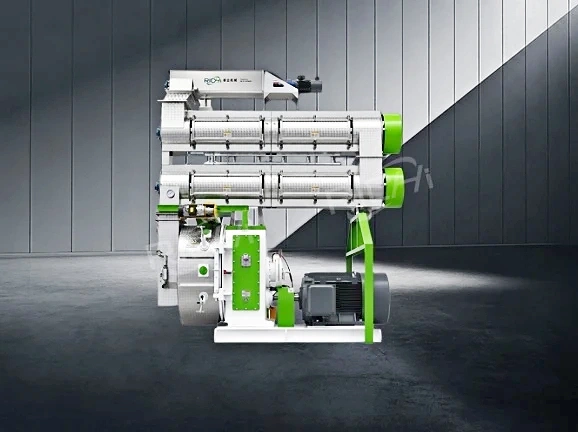
Flat-die machines are often associated with relatively small-scale applications. They can be attractive for farms that need moderate quantities of feed and prefer a simpler production setup.
Ring-die systems are generally more appropriate for larger continuous production. They can provide higher throughput and are widely used in commercial feed plants.
Neither option is universally better.
A farm producing several hundred kilograms per hour has different requirements from a factory producing multiple tons per hour. The correct choice should reflect actual demand rather than perceived equipment prestige.
Think About the Complete Production Line
A pellet mill is only one part of a feed processing system.
A typical production process may include:
- Raw material receiving
- Cleaning
- Grinding
- Batching
- Mixing
- Conditioning
- Pelletizing
- Cooling
- Screening
- Packing
Some projects may also require crumbler equipment, conveyors, elevators, storage bins, or automatic weighing systems.
The production line should be designed around material flow. If one machine has much lower capacity than the others, it can become a bottleneck.
For instance, installing a high-capacity pellet machine while keeping an undersized grinder may not increase total production. The grinder could become the limiting point.
Pellet Durability Matters
A pellet that looks attractive when it leaves the machine is not necessarily a good pellet.
Durability should also be evaluated after cooling, screening, transportation, and storage.
Pellets that generate excessive fines can create several problems. Fine particles may reduce feeding convenience, increase dust, and create material losses.
Pellet durability is affected by formulation, moisture, grinding size, conditioning, die specifications, compression, and cooling.
This is another reason why feed pellet production should be viewed as an integrated process.
What Should Buyers Ask Equipment Suppliers?
A good equipment discussion should go beyond price.
Potential buyers should provide information about:
- Target animal
- Feed formulation
- Raw material types
- Expected capacity
- Pellet diameter
- Operating hours
- Available power supply
- Factory space
- Automation requirements
- Future expansion plans
The supplier can then recommend a more appropriate configuration.
Buyers may also ask for production references, equipment drawings, process flow diagrams, spare parts information, installation support, and operator training.
Useful technical information is often available through helpful resources, especially when a producer is still comparing different processing approaches.
Why a Complete Process Can Reduce Operating Problems
A well-designed production line allows each stage to support the next.
Grinding creates suitable particle sizes. Batching establishes formulation accuracy. Mixing improves uniformity. Conditioning prepares the material. Pelletizing forms the pellets. Cooling stabilizes them. Screening removes excessive fines. Packing protects the final product.
When these steps are properly matched, the system can operate more consistently.
In contrast, an inexpensive machine installed without considering the upstream and downstream equipment may create recurring problems.
For example, poor cooling can cause condensation inside storage bags. Insufficient screening can allow excessive fines into the final product. Inadequate grinding can reduce pellet quality.
The initial equipment price is therefore only one part of the total investment.
Consider Future Expansion
A farm’s feed demand can change.
A small livestock producer may initially produce feed only for its own animals but later begin selling feed to nearby farms. A commercial feed producer may start with one formulation and add several others.
When planning a plant, it can be useful to leave room for future expansion.
This does not mean buying unnecessarily large equipment from the beginning. Oversized machinery can increase investment and operating costs.
Instead, the pellet production line can be designed so that additional equipment, storage, or packaging capacity can be added later.
Final Thoughts
Selecting a feed granulation system is fundamentally a matching exercise.
The best equipment is not necessarily the biggest or most expensive machine. It is the system that fits the feed formulation, animal requirements, production target, available space, labor conditions, and future business plans.
Whether the project focuses on rabbit feed, poultry feed, livestock feed, or mixed animal diets, producers should evaluate the entire process from raw material preparation to final packaging.
By approaching equipment selection from the perspective of the final feed product rather than the machine alone, farmers can make more informed investment decisions and build a production system that is easier to operate and expand.